Elementary, My Dear Galaxy: Just Call LLM
Posted on March 3, 2026 (Last modified on March 23, 2026) • 8 min read • 1,702 wordsProfile your photo library and much more in LLM-enabled Galaxy workflows
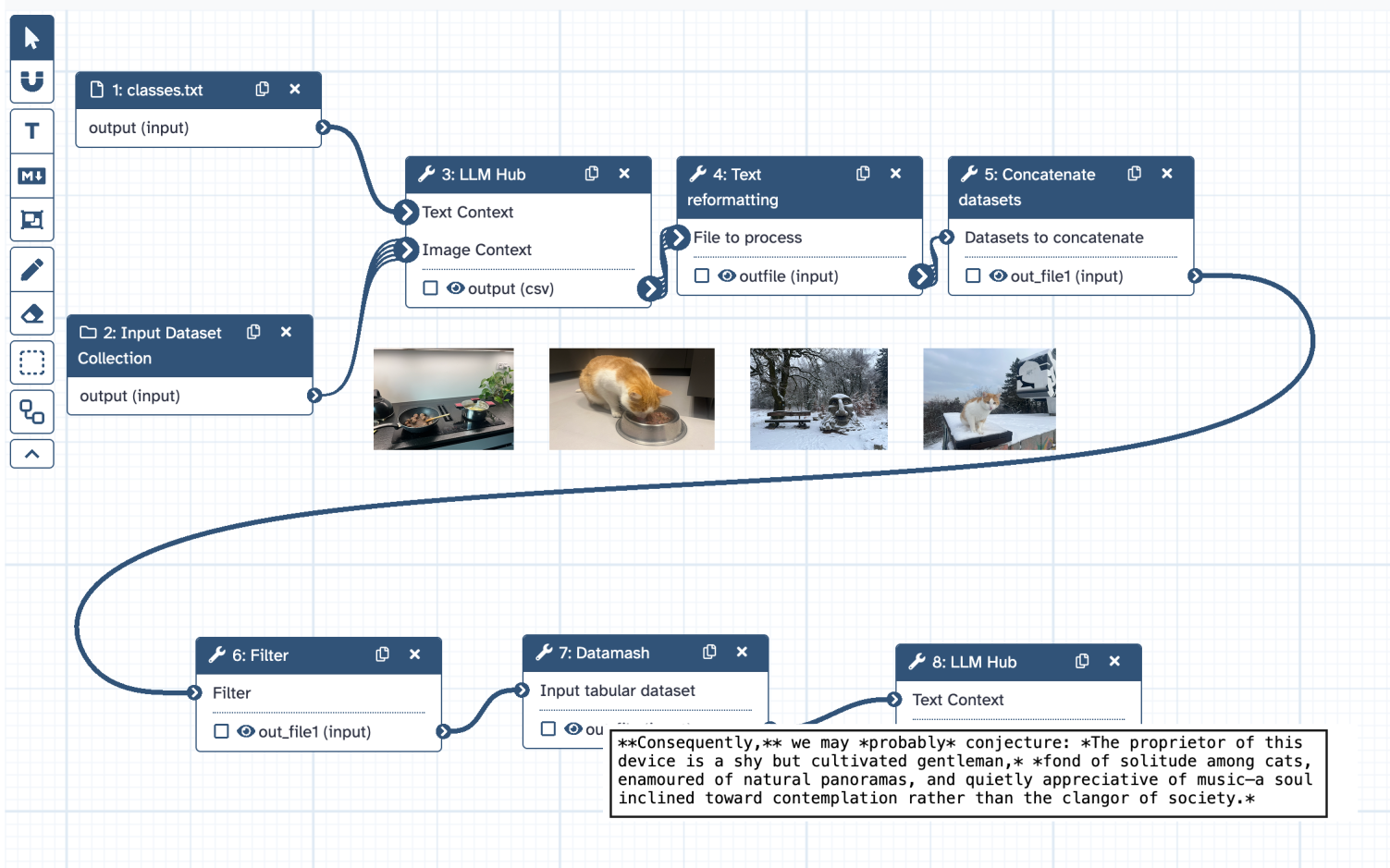
Step by step assembly of Galaxy workflow containing LLM calls
In this article we go step by step in assembling a Galaxy workflow from LLM calls and several conventional Galaxy tools. The use case itself is ridiculous, its only purpose (besides the fun of it) is a demonstration how these can work together and what is the added value of the Galaxy environment in such tasks.
While we use a fun digital archaeologist persona (analyzing photo libraries with Sherlock Holmes-style commentary) to demonstrate the pipeline, the underlying pattern applies to serious use cases: microscopy image screening, satellite imagery classification, medical imaging triage, or archive digitization workflows.
Galaxy
Galaxy is a free, open-source system for analyzing data, authoring workflows, training and education, publishing tools, managing infrastructure, and more. galaxyproject.org
And that’s it, the quotation of the website summarizes everything important. Forget about a notebook with many pages of nobody-can-remember-this commands, and don’t be afraid of forgetting how on Earth some file was generated. At the same time, the powerful computing resources are still at hand.
E-infra CZ installation: usegalaxy.cz
We provide a dedicated installation of Galaxy for the users of e-Infra CZ. The software toolkit is similar to the global, generally available installations at usegalaxy.org and usegalaxy.eu and the computations are backed by the MetaCentrum Grid.
See also specific usegalaxy.cz documentation.
Large language models at usegalaxy.cz
usegalaxy.cz is connected with our AI as a service via the LLM Hub tool (see original announcement).
Technically, usegalaxy.cz keeps credentials to talk to the LLM service, sending inputs (prompts) to the selected LLM, and receiving its outputs. By wrapping the calls to a Galaxy tool, the LLM functionality is fully integrated, and it can be used in manually or automatically run workflows, being combined with thousands of other maintained Galaxy tools.
Profile-the-photos workflow
Previous Galaxy experience is not strictly expected but the tutorial is still quite brief to keep it reasonably short. If you get lost, refer to documentation and tutorials or ask your favourite LLM for help (they are fairly good in it).
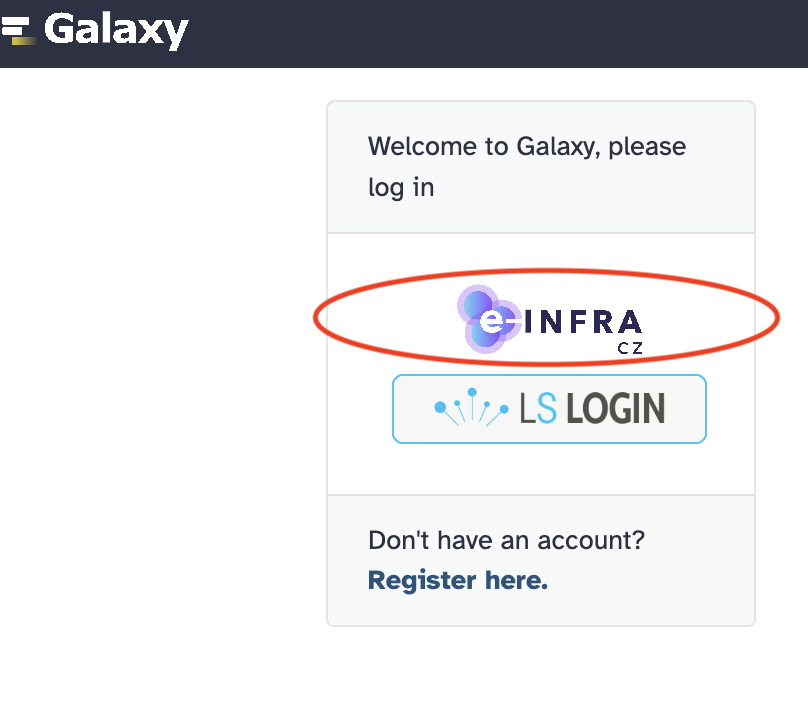 Proceed to
usegalaxy.cz and click on the e-Infra CZ logo in the upper left corner of the login page.
Proceed to
usegalaxy.cz and click on the e-Infra CZ logo in the upper left corner of the login page.
The workflow described below looks a little complicated. Don’t be scared, we take short steps and show them in detail. They can be glued together to Galaxy workflow and run with a single click, as shown at the end of the section.
Test Example: Classify an image
Let’s start with a simple task. One would not need Galaxy for this but it’s a necessary baby step to show how Galaxy wraps the LLM invocations.
- Pick a favourite photo from your phone and save it as medium sized (800x600) file, preferably in PNG format (the safest one wrt. weird format dialects of JPEG etc.).
- Click
Uploadbutton in Galaxy, thenChoose local file, pick the file, and click onStart. Once the file is uploaded (100%), clickClose - Create a file
classes.txtan fill it with categories you would like the images to be classified to. I used:and upload it to Galaxy in the same way as the image.music cat flower food ...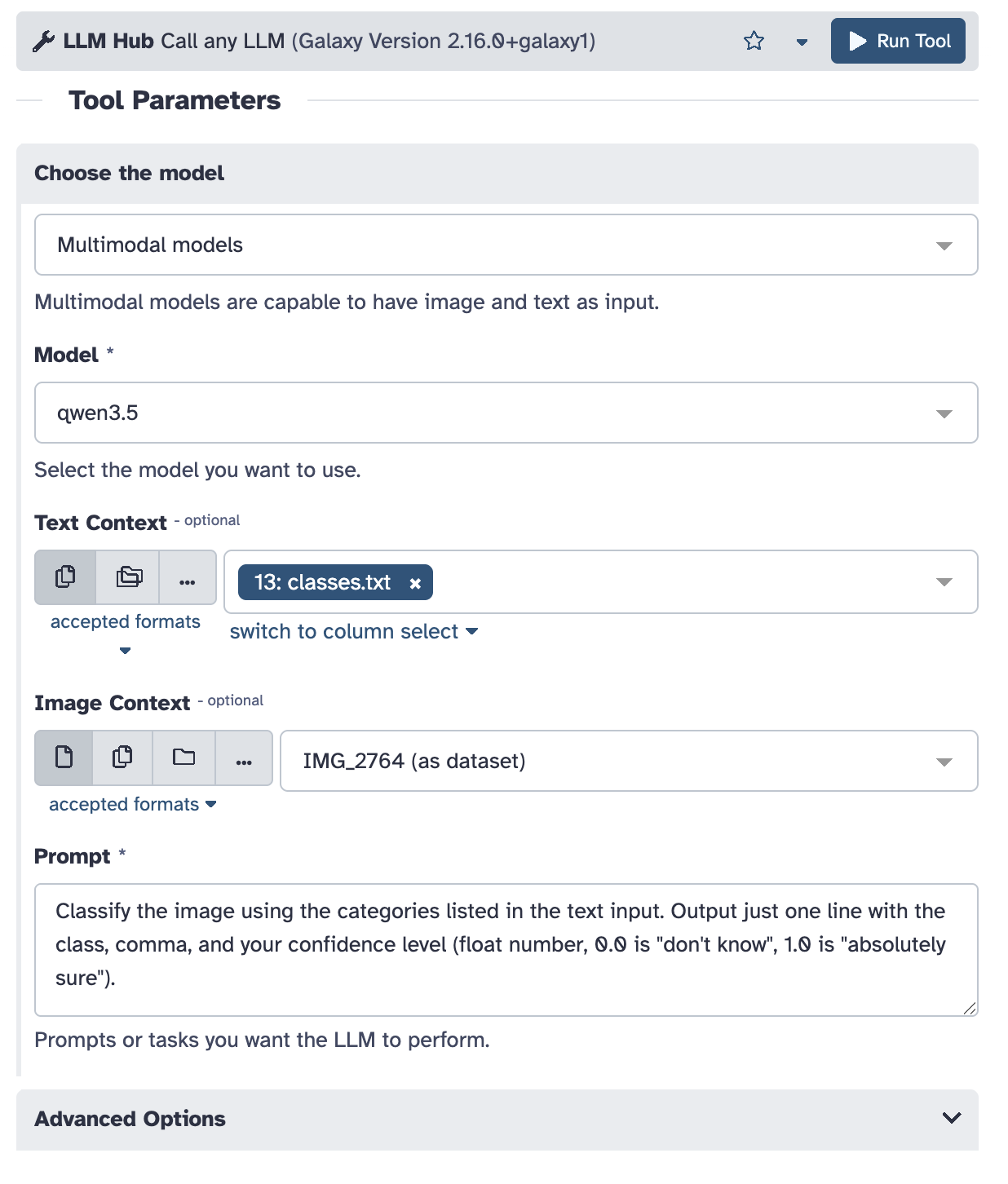
- Click
Toolsand search forLLM Hub, and click on it to get the tool input dialog. - Fill in the dialog in a similar way:
- Pick
Multimodal models, choose one of them,qwen3.5worked for me - Pick
classes.txtas theText contextand your photo forImage Context - Provide suitable promt to tell the model what to do. Be picky to avoid too much LLM creativity, I used:
Classify the image using the
categories listed in the text input.
Output just one line with the class,
comma, and your confidence level
(float number, 0.0 is `don't know`,
1.0 is `absolutely sure`).
- Pick
- Click
Run Tool. It starts crunching, and depending on the load of our LLM service, you get the results in a few seconds or minutes.
Example 2: Analyzing photo libraries with Sherlock Holmes-style commentary
Classify images in a batch
Galaxy provides specific support for handling multiple (even numerous) files in batches. Instead of uploading files one by one, use Galaxy’s collection feature:
- Start with the upload dialogue again, but instead of the default
Regulartab, chooseCollectionnow. - Click
Choose local fileand select multiple image files now (PNG, 800x600 approximately). Stick with a dozen or two – the more you have, the more fun will come, but also the more time you will have to wait. - Click
Startfollowed byBuild(once the latter is enabled) - Enter
imagesas the list name and clickCreate list - Invoke the
LLM Hubtool again; this time, choose the folder icon forImage Contextand pick the collection of images to the field, and as theText contextpickclasses.txtfile. - Provide a suitable prompt to tell the model what to do (use that from the previous example).
- Click
Run Tool.
Depending on the number of files and the current LLM load, processing will take a while now. Have coffee in the meantime. The result is a list of single-line files again, each corresponding to an image in the input list.
Concatenate classifications into a single table
The raw output needs normalization. Instead of manual datatype changes, use the Text reformatting tool.
- LLMs tend to output incomplete lines, which may break the result concatenation.
This can be fixed by calling the
Text reformatingtool. Find it in the tool column, provide the output (the whole list) of the LLM Hub (typically, Galaxy names it likeLLM Hub (qwen3.5) on collection XX), and fill the magic lineas{print $0}AWK Program. - Run
- One more hack – LLM tools annotate their output to be
markdowntype. We need to change it tocsvfor further processing. Click on the pencil icon (Edit attributes) with the output of the previous step (Text reformatting on collection ...), chooseDatatypestab, pickcsvand click onSave. - Search for the
Concatenate datasetstool, chooseText reformatting on collection ..., and run. It produces one table with the classification results.
Filter out low-confidence classifications
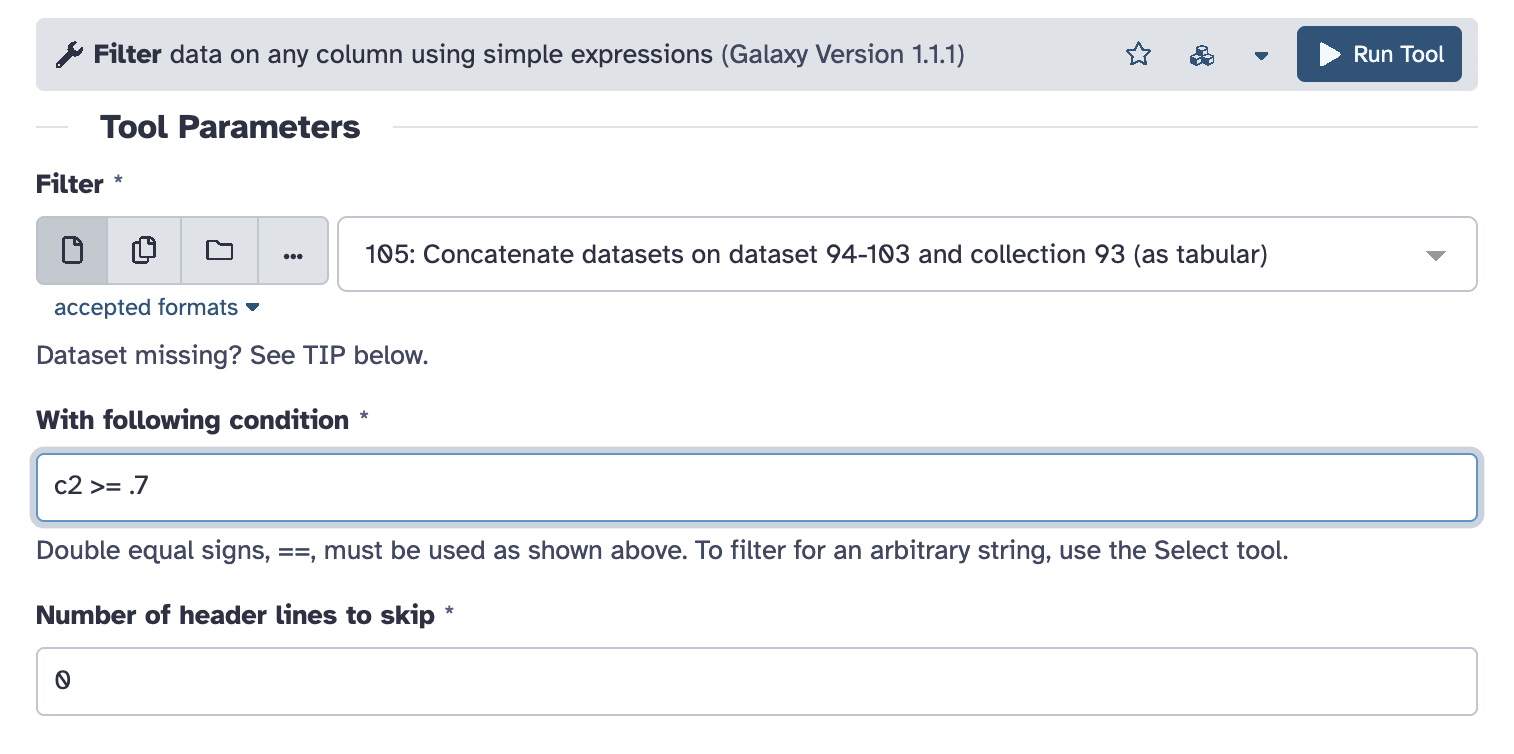 We asked LLM to express how sure it is about classification of each image.
Now is the time to exclude the less confident ones.
We asked LLM to express how sure it is about classification of each image.
Now is the time to exclude the less confident ones.
Run the Filter tool on the previous input (Concatenate datasets ...)
specifying the condition of the filter.
The confidence is the second column in the table, hence c2.
Choose whatever value you find reasonable with your classified images.
Count the results
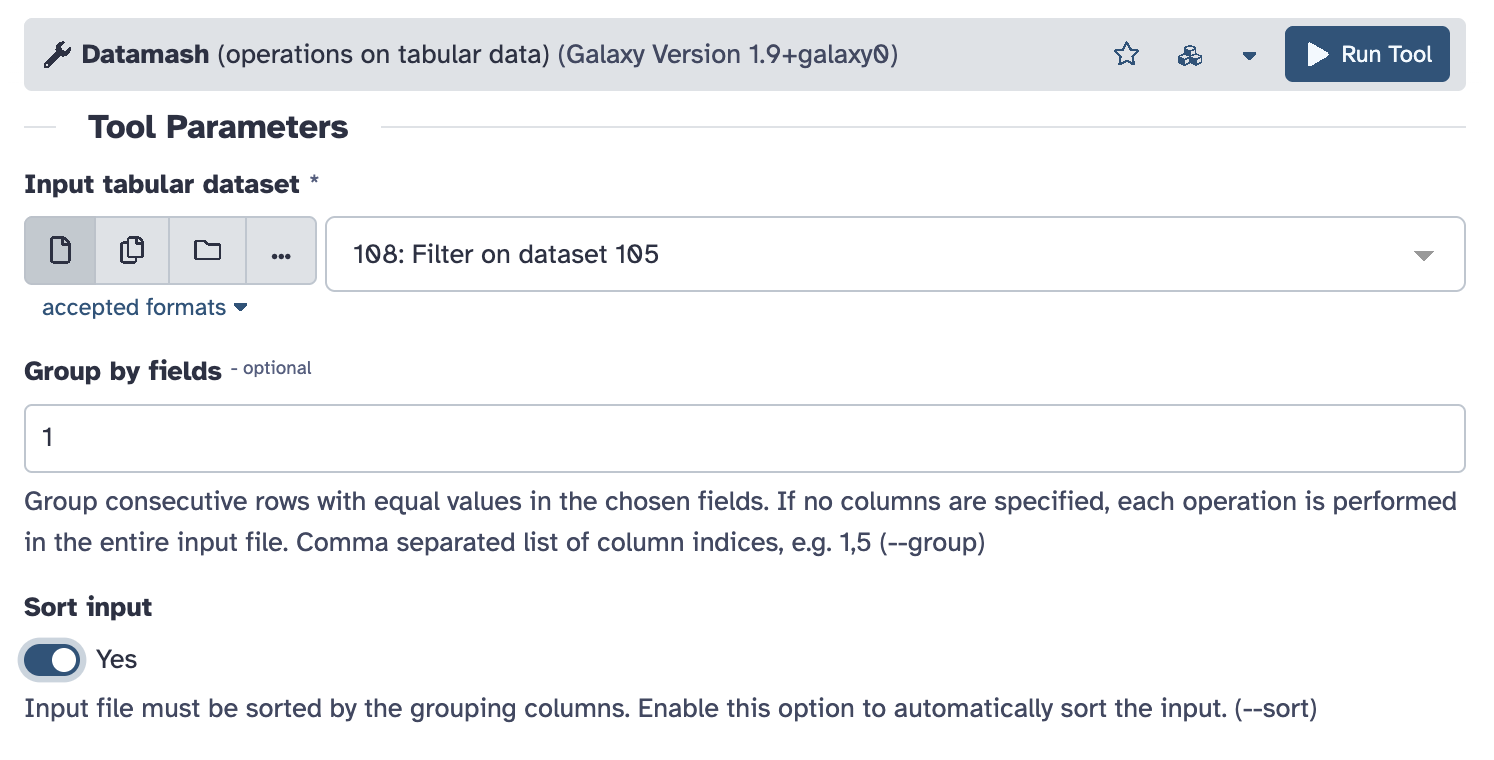 Finally, count the number of distinct classifications with the
 Datamash tool.
Use the output of previous step (Filter on dataset ...) as input,
set Group by fields to 1 (the first column), and enable Sort input checkbox.
Leave all other as defaults, in particular Operation to perform to be count on column 1, and run.
Ask LLM what it thinks about you
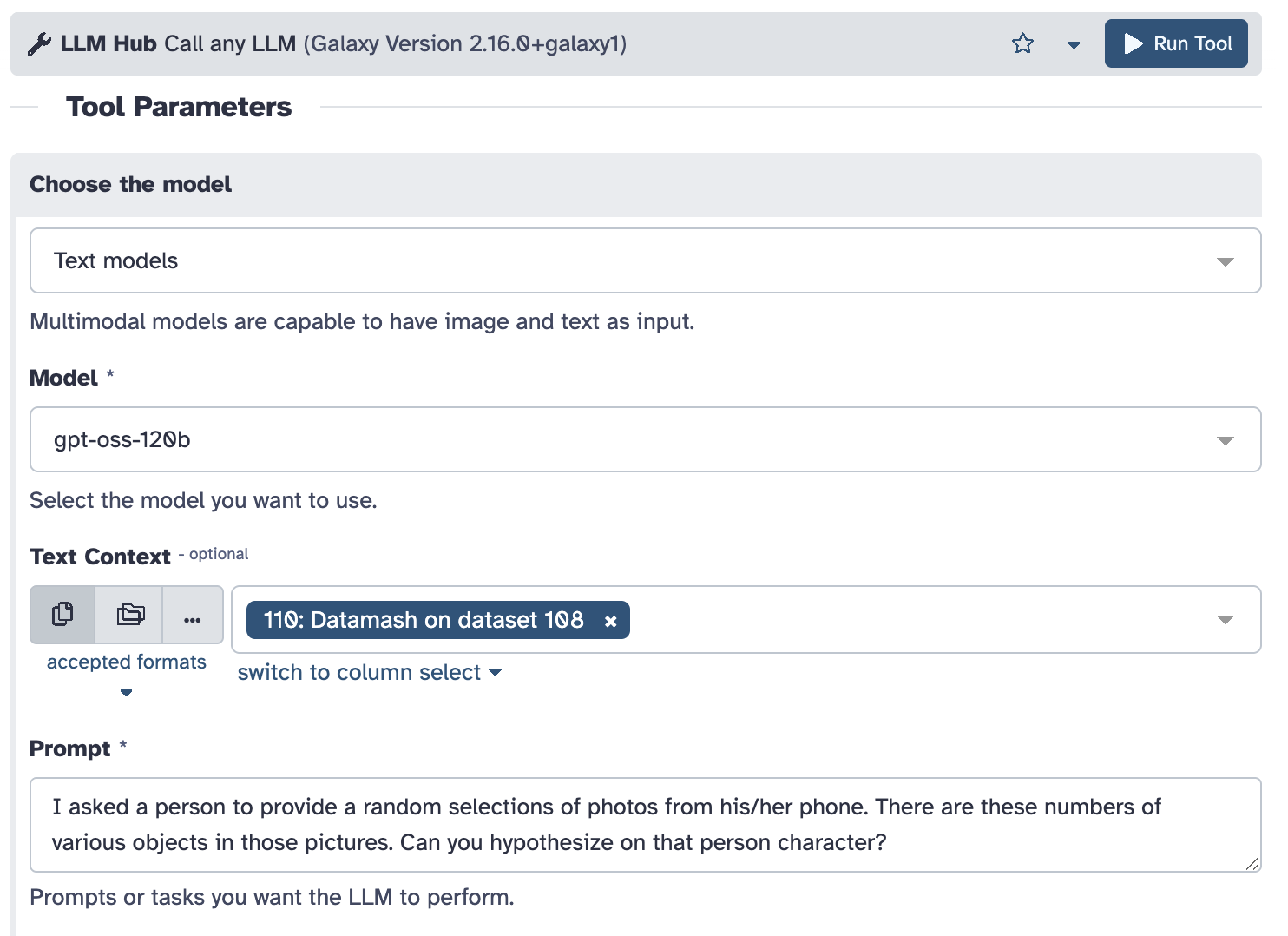 Finally, call LLM again to assess the table with the counts.
In this case, choose
Finally, call LLM again to assess the table with the counts.
In this case, choose Text models and gpt-oss-120b, pick output of the previous step for input,
and provide suitable prompt. Mine was:
I asked a person to provide a random
selection of photos from his/her phone.
The input are numbers of various objects
in those pictures. Can you hypothesize on
that person character? Use the language
and attitude of Sherlock Holmes.
Optionally, Temperature parameter among Advanced Options can be set above 1.0
to take the LLM high and produce more hallucinating outputs.
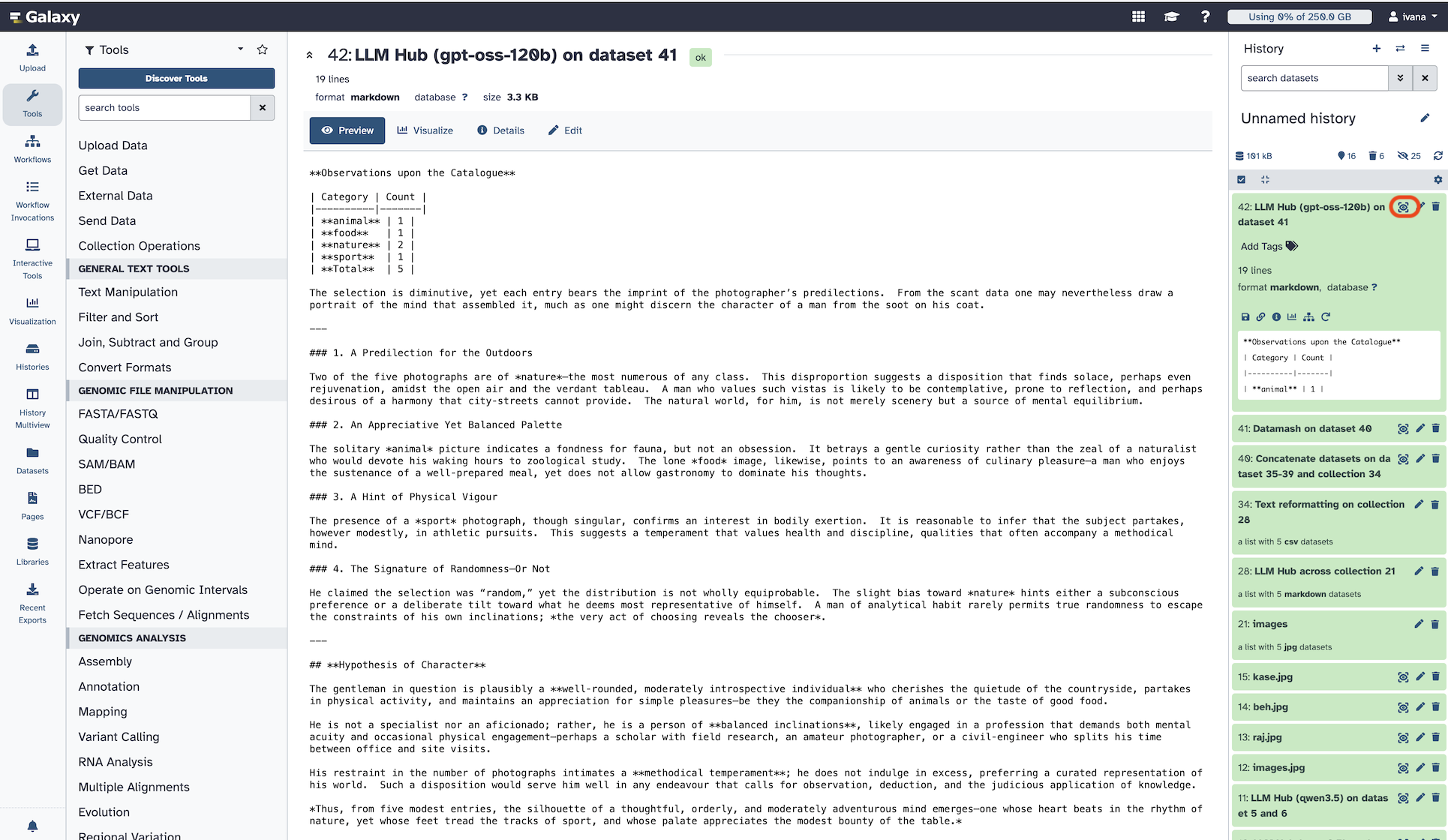
As a result, you receive a detailed detective-style description of your characters, created by analyzing the pictures you provided to the LLM. Based on these observations, it produces a vivid profile similar to a detective’s case report—highlighting distinctive features.
Tip:
- Switch to a model such as kimi‑k2.5 or Deepseek-3.2-thinking.
- Increase the temperature setting to 1.8 for more creative outputs.
- Then feed the model the prompt provided below.
You have been given a set of data that corresponds to the various objects appearing in a random assortment of photos taken by an individual’s phone. Based on these object counts alone, devise a plausible profile of the person’s character and approximate age.
Style: Write your analysis in the voice and deductive tone of Sherlock Holmes—precise, observant, and a touch theatrical.
Scope: Limit the speculation to what can reasonably be inferred from the object frequencies; avoid unfounded or overly speculative claims.
Structure:
- Opening Observation: Briefly note what the data suggest at first glance.
- Deductive Reasoning: Walk through the logical steps linking specific objects (e.g., sports equipment, books, kitchenware, pets) to personality traits and likely age ranges.
- Conclusion: Summarize the most likely character profile and age bracket, phrasing it as Holmes would—confident yet open to revision should new evidence arise.
Putting it all together
 In previous steps we demonstrated manual, exploratory approach to data analysis in Galaxy.
This is typical in the initial stage when the user defines the exact processing steps.
In previous steps we demonstrated manual, exploratory approach to data analysis in Galaxy.
This is typical in the initial stage when the user defines the exact processing steps.
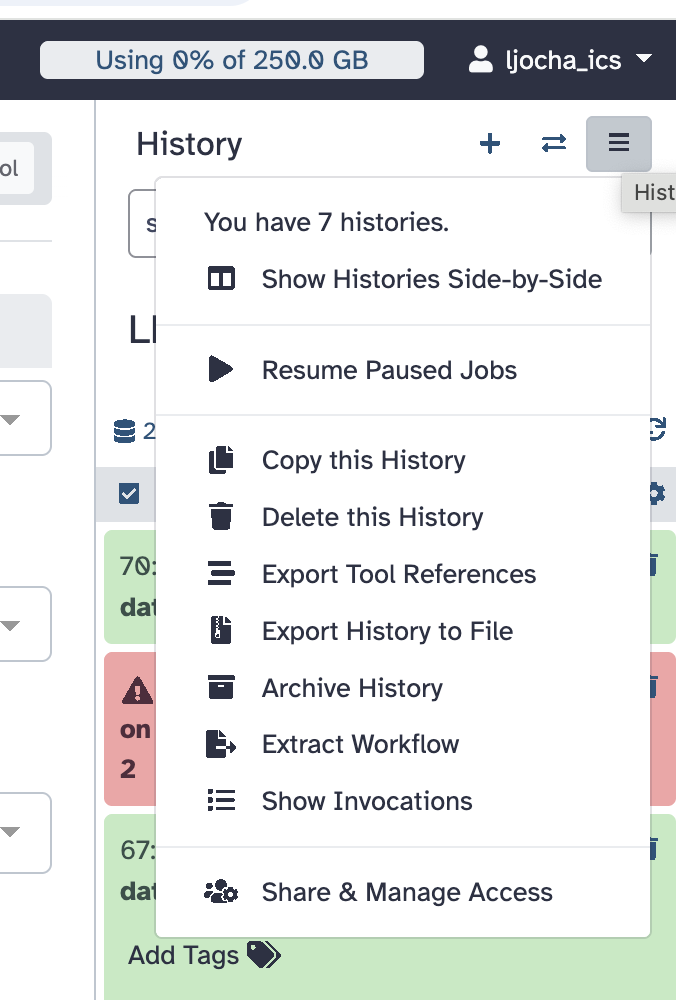
Once the procedure settles down, it is desirable to make a reproducible
record of it.
Galaxy is particularly good in it, there is Extract Workflow command in the
history menu in the upper right corner of the interface.
Working with it can be a bit tricky, detailed description is beyond the scope of this article,
refer to the documentation or proceed with trial and error.
The workflow is a graph of tools connected by edges whenever the output of one is used as an input
of another (see also the heading image of this article).
Besides this connectivity, the additional parameters and settings of tools invocation are recorded
as well.
With a well-designed workflow, the user just provides the inputs, he/she tunes some parameters if needed, and everything gets executed automatically, producing the final results.
My extracted and polished workflow of the profile-the-photos example is available here.
What next?
One could extend the workflow with other image processing tools, there are dozens of them available in Galaxy. Additional image features can be merged with classification, added as input to the final assessment, getting it more accurate.
Or stop playing with this artificial example and move on to serious scientific usage. We will be happy to provide support at galaxy@cesnet.cz.
It’s all up to you, enjoy.
Reference
Documentation usegalaxy.cz